
From tiny bounce to full fleece
Lamb vs Sheep: The Complete Guide to Names, Ages and the First Year
Is a lamb a baby sheep? Learn the difference between lambs, ewes, rams and yearlings, plus the milestones of a sheep’s remarkable first year.
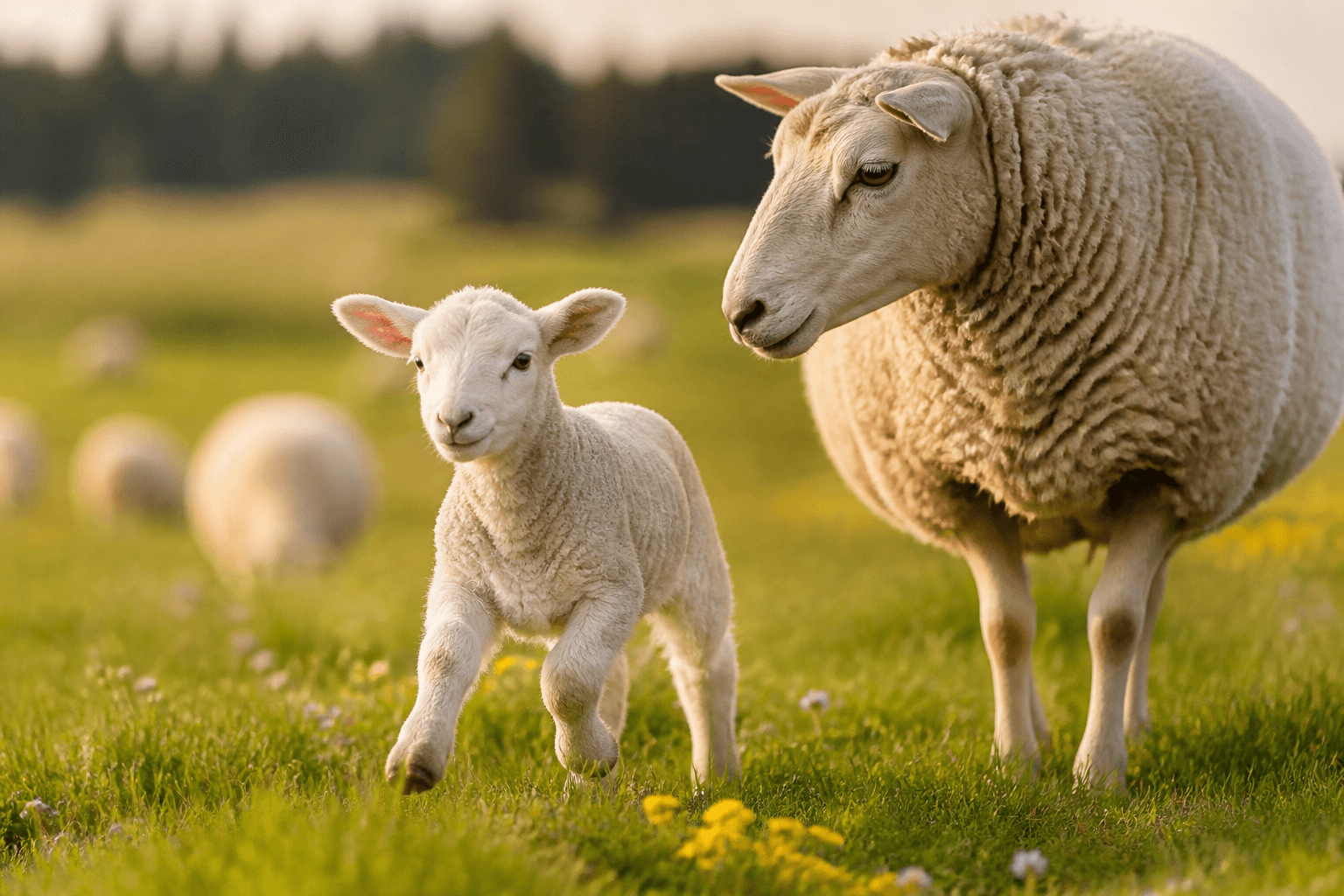
Every lamb is a sheep, but not every sheep is a lamb. That sounds like a woolly logic puzzle, yet the vocabulary is simple once age and sex are separated. The more interesting story is what happens between a newborn’s first breath and the confident young sheep racing across a field months later.
Lamb, sheep, ewe or ram? The vocabulary first
Sheep names describe species, age, sex and sometimes reproductive status. ‘Sheep’ is the broad term for the species at any age. ‘Lamb’ usually means a young sheep in its first year, although agricultural, culinary and regional definitions do not always draw the boundary in exactly the same place.
An adult female is a ewe, an adult intact male is a ram, and a castrated male is a wether. A yearling is an animal around one to two years old, but local farm language varies. ‘Ewe lamb’ and ‘ram lamb’ identify sex while the animal is still young.
- Sheep: the species at any age
- Lamb: a young sheep, generally under one year
- Ewe: an adult female sheep
- Ram: an adult intact male sheep
- Wether: a castrated male sheep
- Yearling: a young sheep in its second year
The first minutes: stand, search, drink
A healthy newborn faces an urgent sequence. Breathing must establish, body heat must be maintained, and the lamb needs to stand and find the udder. Colostrum—the ewe’s first milk—delivers concentrated energy and immune protection. Timing and adequate intake are crucial because a newborn has limited energy reserves and immunity transfer is most effective early.
The ewe licks the lamb, helping dry it while learning its scent. Low maternal calls keep contact close. Farm teams observe without unnecessary disruption, stepping in when breathing, warmth, maternal behaviour or nursing is not progressing safely.
Why lambs bounce: play with a practical purpose
Once steady, lambs reveal an astonishing amount of spring-loaded energy. They sprint, leap with all four feet, pivot, climb small rises and form temporary play groups. The stiff-legged leap often called pronking or stotting is impossible to watch without suspecting that gravity has briefly become optional.
Play is more than entertainment. It develops coordination, strength and social skills and lets young animals practise movements in a lower-stakes setting. A quiet lamb is not automatically unwell, but a marked loss of normal energy alongside poor feeding, hunched posture or isolation needs attention.
Milk, grass and a changing rumen
A newborn begins life dependent on milk, but curiosity soon brings grass, hay, water and the behaviour of grazing adults into view. The rumen is not functioning like that of a mature forage-eater on day one. Solid feed supports its development, and the digestive system changes substantially as the lamb grows.
Weaning is a managed transition, not simply a birthday. Timing depends on growth, health, intake, the ewe, climate and the farm system. Abrupt nutritional and social changes can be stressful, so competent management plans the process and watches both lambs and ewes.
How fast does a lamb grow?
Growth varies enormously by breed, litter size, sex, milk supply, forage, health and environment. A single lamb with abundant milk may follow a different curve from twins or triplets. Numbers are useful only when interpreted for that farm and genetic background.
Keepers use weight, body condition and development rather than judging by fluffiness. A full fleece can disguise the body beneath it, while a recently shorn young sheep may appear to have halved in size overnight. Growth monitoring helps identify individuals who need investigation or a different feeding plan.
Teeth, birthdays and the end of lambhood
Young sheep begin with temporary lower incisors. The first pair of permanent incisors commonly emerges at roughly one year to 18 months, though timing varies. Later pairs appear in sequence, making teeth a useful age estimate when birth records are missing.
There is no dramatic ceremony at which the flock announces adulthood. Legal, showing, production and everyday definitions can differ. Good writing therefore states the intended meaning rather than pretending one word boundary governs every country and context.
A lamb is not a miniature pet
Bottle-fed lambs can become very familiar with people, which is charming and occasionally chaotic. But every lamb grows into livestock with species-specific needs: compatible sheep companions, safe grazing, fencing, shelter, preventive care, appropriate nutrition and skilled handling.
Human attachment does not replace a flock. Male lambs in particular can become dangerous if play-pushing is encouraged and later repeated with an adult ram’s weight and strength. Kind care includes boundaries that will remain safe when the tiny forehead is no longer tiny.
Watching the first year through the flock
The best way to understand lamb development is not a montage of isolated cute moments. Watch the shifts: sleeping close to the ewe, copying grazing, joining a play group, ranging farther, growing a recognisable fleece and finding a place among other young sheep.
Through SheePatron’s bracelet-camera livestream, members see the field at flock level and can catch the social context around young animals without handling them. The camera belongs to a selected sheep, so the experience is about following a real individual’s day rather than turning lambing into an on-demand performance. Meet the flock or explore packages.
Frequently asked lamb questions
Is a lamb simply a baby sheep? Yes, in everyday language. When does a lamb become a sheep? It is already a sheep biologically; ‘lamb’ usually describes the first year, while exact industry definitions vary. What is a female lamb called? A ewe lamb. What is a male lamb called? A ram lamb, unless castrated, when ‘wether lamb’ may be used.
Do lambs need to drink water if they have milk? Clean water should become available as lambs begin exploring solid feed. Can lambs live alone? No—like adults, they are social animals. Our guide to why sheep need companions explains why one photogenic lamb is not a complete flock.