
Fluent in baa
What Are Sheep Saying? A Guide to Bleats, Ears and Body Language
Learn what sheep bleats can mean, how to read ears and posture, why context matters, and what the flock may be communicating on camera.
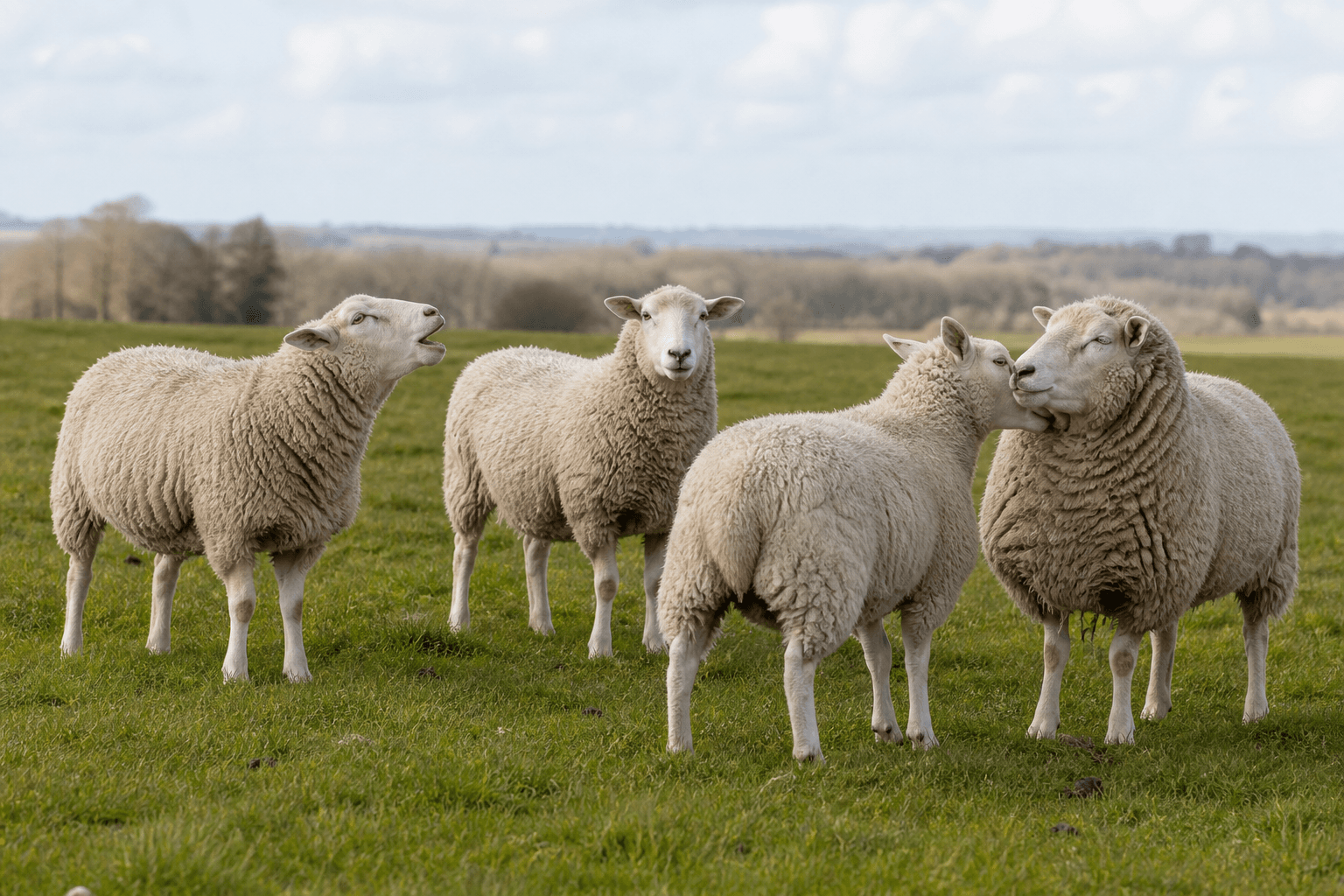
Sheep do not spend the day shouting ‘baa’ at random. They communicate through calls, ear positions, gaze, scent, distance, touch and movement. There is no pocket phrasebook that translates every bleat into one sentence, but careful observation can reveal a surprisingly rich social conversation.
First rule of sheep translation: context is everything
A sound has no reliable meaning when separated from the animal, the moment and what happens next. A ewe calling immediately after lambing, a sheep answering from across a field and an animal vocalising during handling may produce superficially similar sounds for very different reasons.
Read clusters of evidence: who is present, whether the flock is moving, how the ears and body are held, whether the call repeats, and whether normal grazing or rumination resumes. Translation begins with a whole scene, not an isolated audio clip.
- Listen to pitch, rhythm, volume and repetition
- Watch ears, head height, muscle tension and movement
- Notice the distance between the caller and the flock
- Compare the behaviour with that individual’s normal pattern
Why do sheep bleat?
Bleating helps sheep maintain contact. Ewes and lambs use vocal cues alongside scent and appearance to find and recognise one another, especially in the noisy confusion of a flock. Adults may also call when separated, anticipating food, locating companions or responding to an unfamiliar event.
Not every bleat is distress, and silence does not guarantee comfort. Sheep are a prey species and can show pain or illness subtly. A sudden change—persistent calling, isolation, reluctance to move, unusual breathing or loss of appetite—matters more than whether a sound seems dramatic to a human listener.
The mother-and-lamb conversation
Soon after birth, ewe and lamb build a selective bond. Low-pitched maternal bleats are part of close contact, while stronger calls can help reunite a separated pair. Smell is crucial at close range, and visual and vocal recognition become increasingly useful as lambs mingle.
A lamb may call when hungry, cold, unable to find its mother or briefly separated during ordinary movement. The response must come from the keeper, not an internet sound chart: the lamb’s posture, temperature, feeding history and the ewe’s behaviour determine whether the moment is routine or urgent.
Ears: the flock’s little signal flags
Sheep ears are mobile and information-rich. An animal may orient them toward a sound, hold them in different directions while monitoring several things, or alter their position with arousal and emotional state. Researchers studying sheep welfare have included ear posture among measures of positive and negative experience.
Breed changes the visible signal. A sheep with upright ears does not present exactly like one with long, drooping ears, and wind, flies or a nearby noise can move an ear without revealing a grand emotion. Look for repeated patterns paired with the face, body and situation.
Posture, distance and the invisible conversation
A relaxed sheep may graze steadily, lie in a normal resting posture or ruminate among companions. Alertness often raises the head and directs eyes and ears toward a stimulus. Fear can tighten flock spacing, increase vigilance and prime animals to move. Aggression may involve a direct stance, pushing, chasing or head-to-head impact.
Distance is communication too. Sheep choose who to stand beside, whom to follow and how tightly to group. A flock spreading comfortably across pasture tells a different story from animals packed together and staring in one direction. One sheep persistently apart from the group deserves attention because separation can accompany illness or injury.
Headbutting, nudging and friendly contact
Headbutting is not one single behaviour. Young sheep may play, flockmates may compete, and rams can use force in serious contests. Context, intensity, body size and the animals involved determine the risk. Never invite a ram to push against a human hand or treat charging as a cute game.
Gentler contact also matters. Sheep investigate, follow, stand close and sometimes rub or nudge. Familiar animals can form stable social preferences. It is tempting to label every interaction with a human emotion, but respectful observation leaves room for sheep behaviour to be interesting on its own terms.
How to watch the livestream like a field naturalist
Start with a two-minute scan. Is your sheep grazing, ruminating, resting or travelling? How far away are the nearest companions? Where are the ears pointing? Then choose one change—a call, a lifted head, a flock movement—and watch what occurred just before and after it.
Try the interactive sheep body-language decoder, then bring that context-first approach to the bracelet-camera livestream. Keep a playful notebook: ‘mystery bucket detected’, ‘three synchronized head lifts’, ‘Mabel answered from off-screen’. Over time, patterns become more meaningful than viral moments.
When communication may be a welfare warning
Contact a keeper or veterinarian rather than attempting remote diagnosis when an animal shows persistent abnormal vocalisation, repeated teeth grinding, laboured breathing, obvious lameness, bloating, inability to rise, prolonged isolation or a marked change from normal behaviour. Camera access is a window, not a clinical examination.
SheePatron’s livestream is part of the member experience; responsibility for monitoring and care remains with the farm team. That boundary makes the view more enjoyable and more honest: members can be curious observers while skilled people on site make welfare decisions.
Frequently asked questions about sheep sounds
Do sheep recognise individual voices? Ewes and lambs learn individually meaningful calls, and sheep can distinguish familiar social information using several senses. Do sheep purr? They may make quiet contented sounds, but ‘purring’ is an informal description rather than a universal scientific category. Why is a sheep suddenly loud? Separation, feeding anticipation, maternal contact and stress are possibilities; context decides.
Are quiet sheep always happy? No. Normal quiet grazing can indicate calm, while an ill sheep may also become unusually withdrawn. The safest interpretation combines sound with posture, appetite, movement, social position and an experienced keeper’s knowledge of the individual.