
See what the flock sees
Why Do Sheep Have Rectangular Pupils? A Sheep’s-Eye View of the World
Discover why sheep have horizontal rectangular pupils, what colours they can see, how wide their vision is, and what the pasture looks like through sheep eyes.
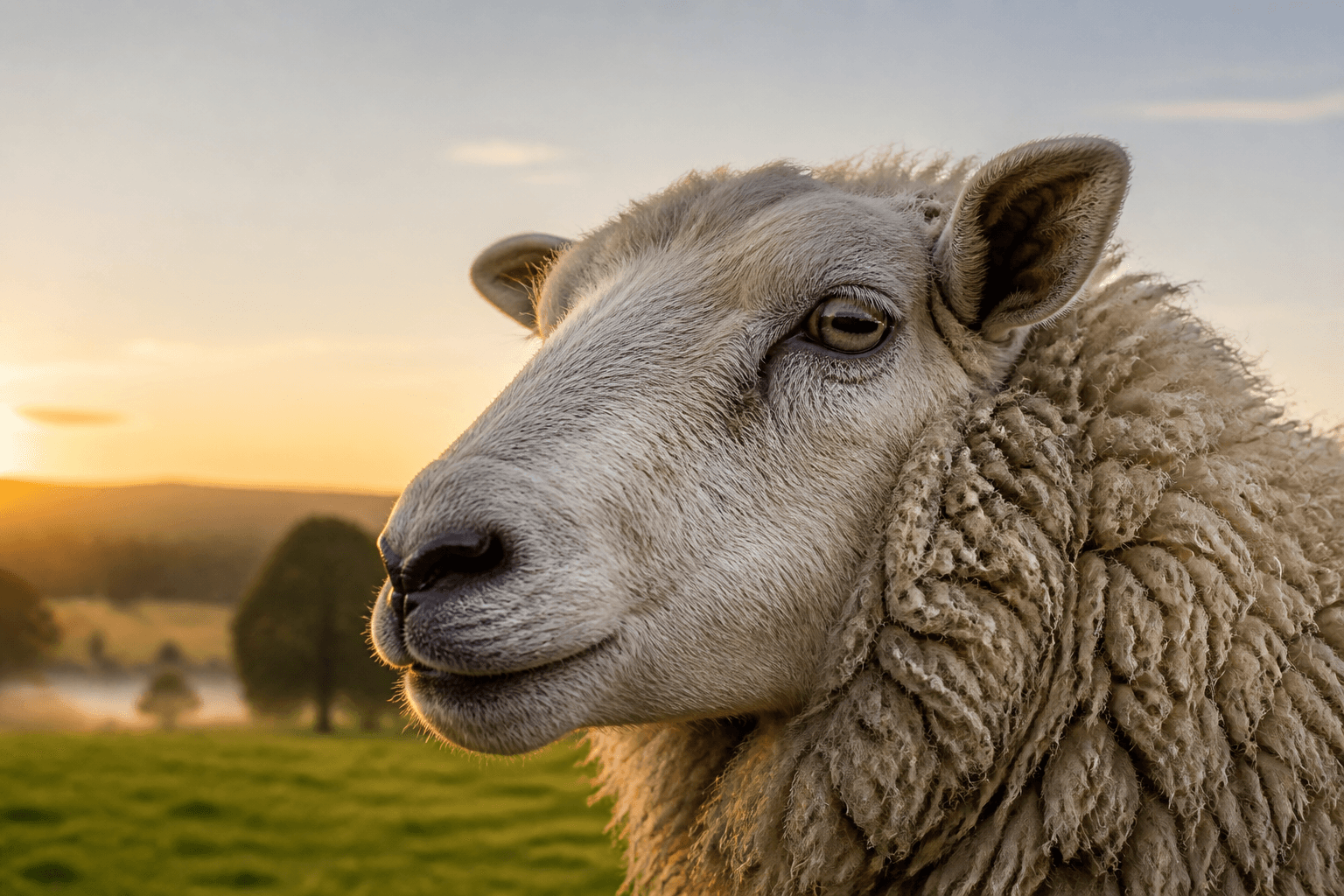
Look closely at a sheep and the eye looking back at you is wonderfully strange: a dark horizontal slot set inside a warm amber or brown iris. That rectangular pupil is not an eccentric design flourish. It is part of a panoramic visual system built for eating with the head down while keeping watch across an open landscape.
The quick answer: a wider window on the horizon
Sheep are grazing prey animals. Their eyes sit toward the sides of the head, and their pupils stretch horizontally. Together, those features provide a broad view around the body, helping a sheep monitor much of her surroundings without constantly lifting or turning her head.
A major comparative study of animal pupils found a strong association between horizontal pupils and plant-eating prey species that are active by day and night. The shape can improve the amount and quality of light arriving from directions along the ground—the very directions from which companions, obstacles and potential threats are likely to appear.
- Side-set eyes increase coverage around the body
- Horizontal pupils prioritise the band of landscape near the horizon
- The visual system supports vigilance while the head is lowered to graze
- Pupil shape is one adaptation among many, not a magical safety guarantee
Why does the pupil stay level when a sheep eats?
Here is the clever part. A sheep spends hours with her nose near the grass, yet the long axis of the pupil does not simply tip toward the ground. The eyes can rotate as the head pitches down, helping the pupils remain aligned with the horizon. Researchers describe this compensating movement as cyclovergence.
Try lowering your own head while keeping your eyes on a distant line and you will feel how different the problem is for a grazer. For sheep, a level horizontal pupil keeps the useful panoramic band of vision oriented across the landscape while lunch is happening. Evolution has effectively supplied a built-in horizon stabiliser—without a settings menu.
Can sheep see behind themselves?
You will often read that sheep have a field of vision of roughly 270 to more than 300 degrees. Exact figures vary with anatomy, breed, head position and how researchers define usable vision, so a single universal number is too neat. The important point is that their visual field is far wider than the forward-focused view of humans.
Wide coverage comes with a trade-off. The area where both eyes view the same point—the binocular field used for precise depth judgement—is narrower than ours. Sheep can still navigate slopes, gates and flockmates, but sudden shadows, high-contrast flooring or unfamiliar narrow spaces may deserve time and careful handling rather than a shove from behind.
What colours can sheep see?
Sheep are not viewing a black-and-white film. Like many mammals, they have two main types of cone photoreceptor rather than the three used in typical human colour vision. Their colour experience is therefore different from ours, with useful sensitivity in blue and green-yellow regions but poorer discrimination among some red, orange and green tones.
Colour is only one piece of visual information. Brightness, contrast, movement, outline and familiarity may matter more in a real field. A flapping bag can be alarming not because it is a particular colour, but because it moves unpredictably and breaks the visual pattern of a known route.
Do sheep see well in the dark?
Sheep are not nocturnal specialists, but their eyes are suited to functioning across changing outdoor light. A reflective layer behind the retina, the tapetum lucidum, sends light through the photoreceptors again and contributes to the bright eye-shine seen when a light catches an animal at night.
Better low-light sensitivity does not mean perfect night vision. Moving between bright sunlight and a dark building still requires adjustment. Calm handling allows the eyes and the sheep attached to them time to assess a doorway, shadow or unfamiliar surface.
How vision shapes flock behaviour
A wide visual field helps sheep maintain contact with one another. Ears, faces, posture and movement all enter that panoramic social picture. When one sheep becomes alert, neighbours can notice the change before any dramatic sound occurs. This is one reason flock movement can look almost choreographed even though no sheep is carrying a clipboard.
Vision also helps explain why approaching directly from behind can startle an animal if you enter a narrower blind area. Good livestock handling makes the handler visible, uses steady movement and works with the animal’s flight zone and point of balance. The goal is understandable movement, not surprise.
A real sheep’s-eye view
A bracelet-camera livestream cannot reproduce a sheep’s retinal biology on a human screen: the lens, colour processing and field of view still belong to the camera. What it can do is place you at sheep height and sheep pace. Grass fills more of the frame. Flockmates drift in and out. A familiar track becomes a daily landmark.
That perspective makes the science easier to feel. Try the interactive Sheep’s-Eye View simulator, then explore SheePatron packages for livestream access or meet the flock before choosing whose view you would most like to borrow.
Frequently asked questions about sheep eyes
Are sheep pupils truly rectangular? They are usually described as horizontal or rectangular, although the outline changes as the pupil constricts and dilates. Do goats have them too? Yes—goats share a broadly similar grazing-prey visual design. Can sheep recognise people? Research shows sheep can learn and discriminate faces, a fascinating ability explored in our guide to sheep intelligence.
Do rectangular pupils mean sheep never look forward? No. Their visual fields overlap in front, and sheep turn their heads to inspect what matters. The shape is an adaptation that changes visual priorities; it does not reduce a living, attentive animal to one optical diagram.